May 27, 2026
Preparing for the Future - Balancing Academic Excellence and AI Skills
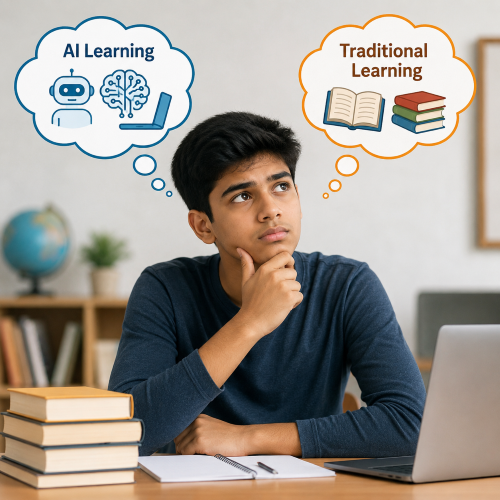
On a warm Sunday afternoon in Kolkata, twelve-year-old Aarav sat at his study table with two screens open in front of him. On one side was a mathematics worksheet assigned by his tuition teacher. On the other was an AI chatbot helping him brainstorm ideas for a science project on renewable energy.
His mother watched from the doorway, puzzled. "Should he spend more time mastering his school subjects," she wondered, "or learning these new AI tools everyone is talking about?"
Across India, millions of parents are asking the same question.
The rise of Artificial Intelligence has transformed how students learn, complete assignments, explore hobbies, and even prepare for careers. At the same time, traditional tuition classes continue to play a critical role in helping students strengthen academic foundations and perform well in examinations.
The debate, however, is often framed incorrectly. The real question is not whether students should choose AI skills over tuition. How can students combine strong academic foundations with future-ready digital skills to thrive in a rapidly changing world? The answer lies in understanding what each approach contributes to a child's growth.
Why Parents are Reconsidering Learning Priorities for Students in 2026
A decade ago, academic success followed a relatively predictable path. Students attended school, joined tuition classes if needed, prepared for examinations, and eventually pursued higher education. While extracurricular activities were encouraged, academic performance remained the primary focus for most families.
Today, the landscape is very different. Students have access to AI-powered learning tools, online courses, virtual tutors, coding platforms, content creation software, and global educational resources. A child can learn graphic design from an instructor in Europe, practice coding through interactive games, or receive instant explanations of complex concepts using AI.
This abundance of opportunity is exciting. It is also overwhelming.
Parents often worry that focusing too much on emerging technologies might distract children from their academic responsibilities. At the same time, they fear their children may fall behind if they ignore the digital skills shaping tomorrow's workplaces. This uncertainty has sparked a nationwide conversation about what students should really be learning in 2026.
How Traditional Tuition Classes Continue to Support Academic Success
Before discussing AI, it is important to understand why tuition classes remain relevant. Despite technological advancements, school curricula continue to demand strong subject knowledge, disciplined study habits, and examination readiness. Many students benefit from structured academic guidance because it provides:
Personalized Attention Beyond the Classroom
School teachers often manage large classrooms, making individualized support difficult. Tuition classes help students clarify doubts, revisit difficult concepts, and receive targeted assistance based on their learning pace.
Stronger Conceptual Understanding in Core Subjects
Mathematics, science, languages, and social studies remain fundamental disciplines. A student who lacks confidence in basic concepts may struggle regardless of how advanced technology becomes. Traditional tuition helps reinforce these foundations.
Improved Examination Preparation Techniques
Examinations still play a significant role in academic progression. Experienced tutors teach time management, answer-writing techniques, revision strategies, and problem-solving methods that help students perform better under pressure.
Consistent Study Discipline and Accountability
One of the greatest benefits of tuition is routine. Regular classes create structure, encourage consistency, and help students maintain focus throughout the academic year. These advantages explain why tuition continues to be a trusted educational support system for families across India.
Understanding Why AI Skills are Becoming Important for School Students
While traditional academics remain essential, another reality cannot be ignored: Artificial Intelligence is becoming part of everyday life. Students already interact with recommendation algorithms, smart assistants, language translation tools, image generators, and AI-powered educational platforms.
The future workforce will almost certainly require familiarity with these technologies.
However, learning AI does not necessarily mean studying complex programming languages or advanced machine learning models. For school students, AI literacy involves understanding how intelligent tools work and how to use them responsibly.
Learning How to Ask Better Questions
One of the most valuable AI-related skills is prompt creation. Students who can clearly define problems, organize thoughts, and ask meaningful questions receive better results from AI tools. Interestingly, this ability strengthens communication skills, critical thinking, and creativity.
Developing Research and Information Evaluation Skills
AI can provide information quickly. However, not all information is accurate. Students must learn how to verify facts, compare sources, identify misinformation, and evaluate credibility. These skills are increasingly important in a world overflowing with digital content.
Building Confidence with Technology
Future careers in healthcare, engineering, business, education, media, and public administration will all involve technology in some form. Early exposure helps students become comfortable adapting to new tools and platforms.
Encouraging Creativity and Innovation
AI tools can assist with storytelling, design, coding, presentations, music composition, and brainstorming; When used appropriately, they become creative partners rather than shortcuts. The goal is not to replace learning – it is to enhance it.
Why Critical Thinking Matters More Than Ever in the Age of Artificial Intelligence
One evening, Aarav proudly showed his father a perfectly written essay generated by an AI tool – “It took only thirty seconds," he said. His father smiled and asked a simple question: "What part of it reflects your own ideas?" Aarav paused.
The answer revealed an important truth – technology can generate content, but it cannot replace independent thinking. As AI becomes increasingly capable, critical thinking becomes even more valuable.
Students must learn to:
Analyze information logically
Identify biases and assumptions
Solve unfamiliar problems
Evaluate multiple perspectives
Make informed decisions
Form original opinions
These abilities cannot be automated easily. In fact, they become more important as automation increases. The students who succeed in the future will not necessarily be those who know the most facts. They will be those who know how to interpret, question, and apply knowledge effectively.
How Digital Distractions and Reduced Attention Span Are Affecting Students
One of the biggest educational challenges facing students today is not Artificial Intelligence, competitive examinations, or even academic pressure – It is attention.
Teachers across schools and coaching institutes increasingly observe that students struggle to concentrate for extended periods. Parents often notice children switching rapidly between apps, videos, games, notifications, and study materials within minutes.
Human attention naturally responds to novelty and stimulation. Digital platforms capitalize on this by continuously presenting new content designed to keep users engaged. Every swipe, notification, and auto-play feature encourages the brain to seek instant rewards and rapid stimulation. For children and teenagers whose brains are still developing, this environment can have a noticeable impact on learning behaviour.
In a world where AI can provide instant answers, attention itself becomes a competitive advantage. Students who can focus deeply, think independently, and engage meaningfully with complex ideas are likely to outperform those who rely solely on rapid information consumption.
How Students Can Use AI Tools Without Becoming Dependent on Them
One concern shared by many educators is excessive dependence on AI. If students allow technology to complete every assignment, genuine learning suffers. The solution is not avoidance. It is responsible usage. Students should use AI as a learning assistant rather than a replacement for effort.
For example:
Use AI to explain difficult concepts after attempting them independently.
Generate practice questions for revision.
Brainstorm project ideas before developing original solutions.
Improve grammar and writing quality while maintaining personal voice.
Explore alternative approaches to problem-solving.
When used this way, AI strengthens learning instead of weakening it.
Best Future-Ready Skills for Students Beyond Academics and Technology
While the discussion focuses primarily on AI and tuition – many of the most valuable future skills belong to neither category. The following human-centred abilities will remain highly relevant regardless of technological advancement.
Communication and Public Speaking
Students who can express ideas clearly enjoy advantages in academics, leadership, interviews, and professional life.
Emotional Intelligence and Collaboration
Future workplaces increasingly value teamwork, empathy, adaptability, and interpersonal communication.
Creativity and Innovation
Original thinking remains difficult to automate. Students who develop creative confidence often discover unique opportunities.
Leadership and Decision-Making
Leadership experiences through clubs, sports, community projects, and extracurricular activities teach responsibility and initiative.
Financial and Digital Literacy
Understanding money management, online safety, cybersecurity awareness, and digital responsibility will prepare students for real-world challenges.
These competencies complement both academic achievement and technological proficiency.
Creating the Ideal Learning Balance Between Tuition Classes and AI Education
For most students, balance is the main key, as different age groups require different priorities.
For primary school students the focus should remain on:
Reading habits
Basic mathematics
Communication skills
Curiosity-driven learning
Creative activities
AI exposure can be introduced through supervised educational tools without becoming a major priority.
Middle school students can begin developing:
Digital literacy
Basic coding concepts
Responsible AI usage
Research skills
Project-based learning
Academic foundations should continue receiving primary attention.
Secondary and higher secondary students can benefit from:
Advanced technology skills
Data literacy
Career exploration
Specialized learning programs
Portfolio development
At this stage, AI becomes a powerful productivity and learning tool when used responsibly. The objective should be to integration rather than substitution.
Common Mistakes Parents Should Avoid When Planning Their Child's Education
As families navigate educational choices, several common mistakes frequently emerge:
Following Trends Without Understanding Purpose
Not every student needs coding classes, robotics programs, or advanced AI workshops; educational decisions should align with individual interests and strengths.
Prioritizing Quantity Over Quality
More classes do not automatically produce better outcomes; an overloaded schedule often reduces motivation and increases stress.
Ignoring Mental Well-Being
Academic achievement should never come at the expense of emotional health, sleep, physical activity, and social interaction.
Comparing Children Excessively
Every child develops differently. Comparisons create pressure without contributing meaningful growth.
Assuming Technology Alone Guarantees Success
Technology is a tool, but character, discipline, curiosity, resilience, and communication are vital traits. Technology is secondary to these.
What Schools, Tuition Centres, and Parents Must Do Together
Preparing students for the future cannot be the responsibility of one institution alone; schools, parents, tuition providers, and students must work collaboratively.
Schools can integrate technology thoughtfully while strengthening conceptual understanding.
Tuition centres can focus on deeper learning rather than rote memorization.
Parents can encourage curiosity, experimentation, and balanced development.
Students can embrace both academic rigor and technological exploration.
When these elements work together, education becomes far more meaningful than examination preparation alone.
The Future Belongs to Learners, Not Just Technology Users
A few weeks after completing his science project, Aarav presented his work before his classmates. He had used AI to gather information, generate ideas, and improve his presentation structure. But the project itself reflected his own observations, conclusions, and creativity. The technology had helped him learn. It had not learned for him: That distinction matters.
As India moves deeper into the AI era, students do not need to choose between traditional tuition and modern technology. They need the wisdom to use both effectively.
Strong academic foundations provide knowledge.
AI skills provide adaptability.
Critical thinking provides judgment.
Creativity provides originality.
Together, they create something far more powerful than any single educational trend.
Key Takeaway
In 2026 and beyond, the most successful students will not be those who simply master AI tools or attend the most tuition classes. They will be the learners who combine curiosity with discipline, technology with understanding, and innovation with strong fundamentals.
And perhaps that is the lesson every parent should remember; the future is not about choosing between academics and AI. It is about preparing children to learn continuously, think independently, and thrive confidently in a world that never stops evolving. Some believe technology will replace traditional learning entirely. Others fear digital tools will damage children's intellectual growth. Reality is far more balanced. Students still need strong academic foundations. They still benefit from disciplined study habits and quality tuition support when necessary.
While digital literacy, AI awareness, adaptability, and technological confidence are becoming increasingly valuable, equal importance should be given to focus, emotional intelligence, creativity, curiosity, communication, and resilience. The future does not belong exclusively to technology experts or examination toppers. It belongs to learners who can think deeply, adapt responsibly, communicate effectively, and continue growing throughout life.

.png)